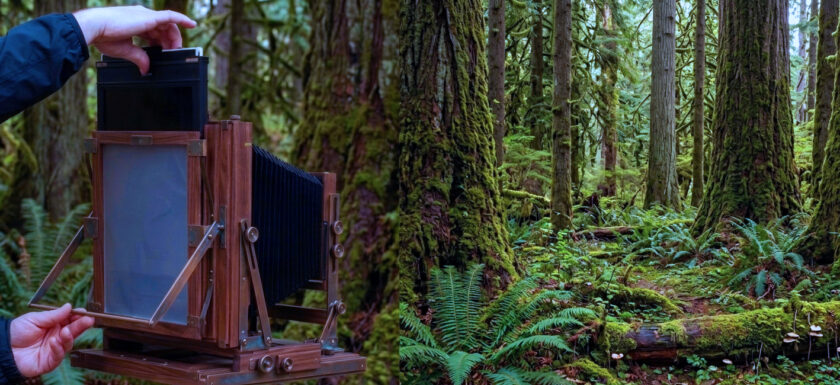
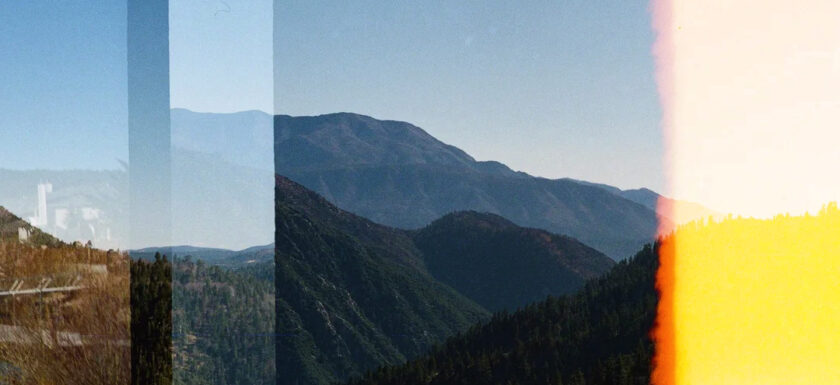
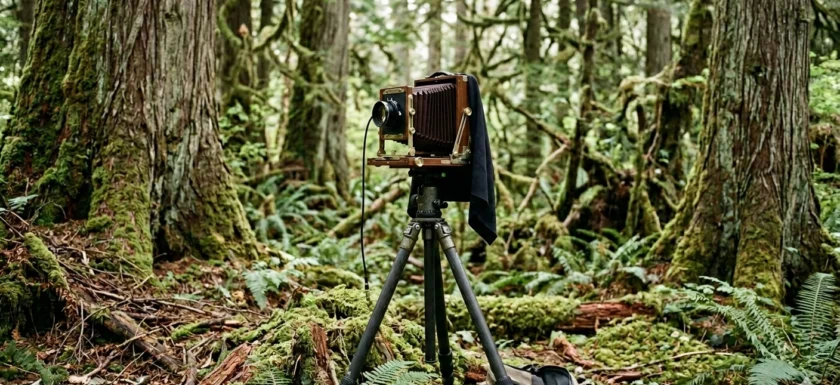
How to Use a Changing Bag to Load Film in the Field There is nothing quite like the experience of shooting film in the great outdoors. Whether you are lugging a 35mm SLR up a mountain trail, capturing sweeping landscapes on medium format, or setting up a massive 4 x 5 large-format field camera among the redwoods, the process forces you to slow down and connect with your surroundings. But out in the wild, an inevitable challenge arises: What happens when you run out of film or need to load a fresh sheet and there isn’t a darkroom for miles? Enter the unsung hero of theRead More →
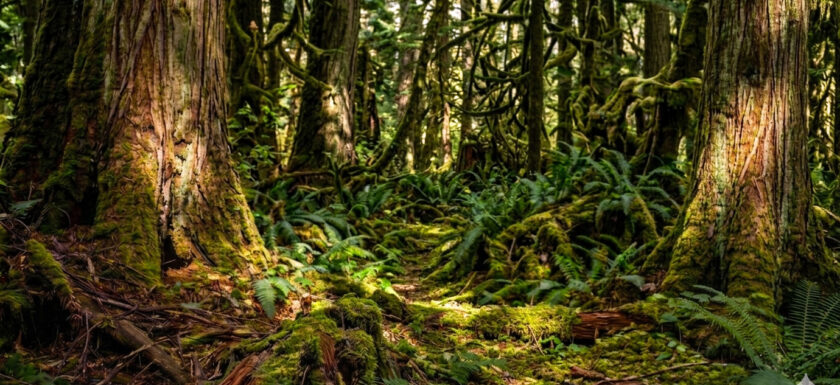
Failure in the Deep Canopy To understand film is to understand that it does not experience time the way a digital sensor does. In normal daylight conditions, light and time share a perfectly linear relationship described by the reciprocity law (E = I x t). If you cut your light in half, you double your exposure time. Simple. But step deep under the ancient, towering cedar canopy of the British Columbia coast, and that elegant math completely breaks down. In the dim, green-tinged twilight of an old-growth forest, your light meter might suggest a two-second exposure. At that speed, film begins to lose its efficiency—aRead More →

The Psychology of the Inverted Image The first time you throw a dark cloth over your head and look at the ground glass of a field camera, your brain experiences a brief moment of panic. The world is entirely upside down and backwards. Left is right, up is down, and the ocean is suspended precariously over the sky. While this optical reality is simply a function of physics—light passing through a single lens element without a prism to correct it—the psychological effect on composition is profound. When you look at a landscape normally, your brain immediately labels what it sees: that is a cedar tree,Read More →

How Focal Length Dictates Your Movement In digital photography, changing your perspective is often as simple as twisting a zoom ring. You stand in one spot and effortlessly transition from a wide-sweeping vista to a tight, compressed detail. With a 4×5 view camera, changing your focal length is a deliberate, physical event that completely alters how you interact with the surrounding terrain. Consider the contrast between carrying a wide-angle lens, like a 90mm, versus a moderate telephoto, like a 210mm, through a rugged coastal environment. The 90mm demands that you get physically intimate with your subject. To make a compelling wide-angle landscape, you need strongRead More →

The Invisible Enemies of Sheet Film When we think of landscape photography, we picture grand vistas, dramatic skies, and rugged shorelines. We rarely picture an adult huddled inside a sweat-inducing nylon changing bag on the floor of a tent, blindly feeling around for pieces of film in total darkness. Yet, this is where the success or failure of a large-format image is truly decided. In the wilds, your greatest enemies aren’t bears or steep cliffs; they are the microscopic, invisible hazards of dust, dampness, and static electricity. Sheet film must be manually loaded into individual film holders. On the BC coast, the relentless humidity isRead More →