
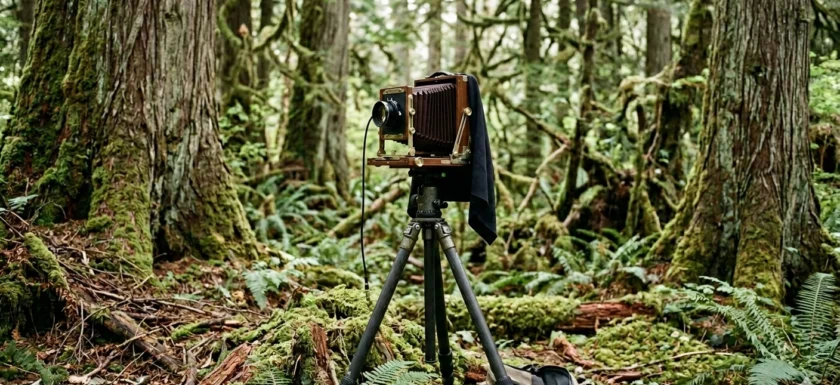
There is a distinct moment on the British Columbia coast when the romance of large-format landscape photography collides hard with reality. It usually happens three miles into a dense trail of wet cedar and salal, rain beginning to find the gap between your collar and your pack, when the twenty-five pounds of aluminium, wood, and glass on your back begins to feel less like an artistic tool and more like an anchor.
In a digital era defined by instantaneous capture, choosing to shoot a 4x5 field camera in the rugged, unpredictable wilderness of the Pacific Northwest isn’t about efficiency. It is about a deliberate shift in pace. It is a commitment to a process where the journey and the setup are just as vital as the final piece of film.
The Haul: Packing the Beast
Photographing the BC coast—from the storm-battered beaches of Vancouver Island to the deep fjords of the Great Bear Rainforest—requires a backpacking strategy that balances survival gear with fragile, analogue mechanics. You aren't just carrying a camera; you are carrying a mobile darkroom infrastructure.
My 4x5 Coastal Pack Layout
Top Pocket:
- Dark cloth, loupe, light meter, filters
Main compartment:
- Chamonix 4x5 Field Camera (wrapped in padded wrap)
- 3 Lenses in lens boards (90mm, 150mm, 210mm)
- 6 QuickLoad or standard film holders (12 shots)
Base/Sides:
- Carbon fiber tripod (strapped securely)
- Rain shell, water, bear spray
Weight distribution is everything. The heavy timber, slick mud, and steep coastal bluffs require your centre of gravity to be tight. A sturdy, waterproof adventure pack is non-negotiable; if you slip on a kelp-covered rock, your gear needs to survive the impact—and the tide.
The Setup: A Dance with the Elements
When you finally find that perfect intersection of tide, mist, and ancient forest, the real work begins. Setting up a 4x5 camera in the wilds of BC is a mechanical ritual that demands absolute focus, especially when the elements are working against you.
1. Plant the Foundations
Before the camera even leaves the pack, the tripod must be anchored. On coastal beaches, this means pushing the tripod legs deep into the shifting gravel or wet sand until they hit solid footing. In the rainforest, it means navigating a spongy floor of moss and decaying logs. If your tripod moves even a millimetre during a two-second exposure, the shot is lost.
2. Unfolding the Field Camera
Taking the camera out of its padded wrap feels like handling a sacred object. You lock the bed into place, erect the front and rear standards, and tighten the knurled knobs. In the cold, damp coastal air, your fingers are often stiff, making the manipulation of these small brass or aluminium controls an exercise in forced patience.
3. Composing Under the Cloth
This is where the world goes away. Throwing a heavy dark cloth over your head to view the ground glass is an isolating, meditative experience. On the BC coast, this step has unique challenges:
The Inverted World: The image on the glass is upside down and backwards. You are forced to look at the dark treeline and crashing surf purely as shapes, tones, and geometry.
The fog factor: Your own breath under the dark cloth can instantly fog the ground glass or the loupe. You learn to breathe downward, away from the optics, controlling your respiration like a marksman.
4. The Choreography of Movements
To capture the towering scale of an old-growth Sitka spruce or to keep the sweeping shoreline in sharp focus from foreground pebble to distant misty headland, you employ the camera’s movements. A bit of forward lens tilt aligns the plane of sharp focus with the ground. A touch of front rise keeps the trees from appearing to fall backward. It is a tactile, intellectual puzzle solved entirely by hand.
5. Shielding the Exposure
Once the composition is locked, the aperture set, and the shutter cocked, you pull a film holder from your pack. This is the moment of highest vulnerability. A single stray drop of coastal rain on the dark slide can ruin the film inside.
You wait for a break in the wind, hold your dark cloth or an umbrella over the camera bellows to act as a windbreak, pull the dark slide, and trip the shutter. Click. A quiet, mechanical sound easily swallowed by the roar of the Pacific.
Why the Process Matters
By the time you slide the dark slide back into place, marking the film holder as "exposed," forty-five minutes might have passed. You have taken exactly one photograph.
But in that forty-five minutes, you haven't just glanced at a landscape; you have lived in it. You have watched the tide creep closer to your boots, noticed the exact speed at which the fog is rolling through the canopy, and felt the specific weight of the coastal air.
Hauling a 4x5 camera through the BC wilds changes your relationship with photography. It strips away the urge to collect endless, meaningless snapshots and replaces it with a deep, physical reverence for the craft of making a single, intentional image.
